
See problems before they spread.
Automated mortality detection, wound scoring, and multi-parameter welfare assessment give you early warning on fish health — without handling a single animal.
17
Welfare parameters monitored
<2 min
Mortality detection alert time
Non-invasive
Zero-handling assessment
Daily
Automated welfare scoring
How It Works - Three steps to health & welfare intelligence.
Scan
Cameras continuously capture fish surfaces, detecting lesions, fin damage, eye conditions, and body deformities.
Score
Each parameter is scored against species-specific baselines. Individual scores aggregate into a pen-level welfare index.
Alert
Anomaly detection flags sudden changes. Mortality events trigger immediate alerts with camera evidence.
Capabilities - What Health & Welfare delivers.
Mortality detection
Dead fish detected on surface or bottom with automatic counting and alert.
External wound detection
Lesions, ulcers, and open wounds identified from camera imagery.
Fin erosion scoring
Dorsal, pectoral, and caudal fin condition scored on a standardized scale.
Eye condition monitoring
Cataracts and exophthalmia detected through close-pass camera observations.
Body condition scoring
Emaciation and deformity detection from body profile analysis.
Skin condition assessment
Discoloration, ulcers, and scale loss estimated across visible body surfaces.
Maturation detection
Early sexual maturation identified through morphological changes.
Jaw and operculum screening
Jaw deformity and operculum damage detected for quality assessment.
Vertebral deformity detection
Spinal curvature and vertebral abnormalities flagged from swim posture analysis.
Parasite detection
Sea lice and visible ectoparasites detected on individual fish.
Stress behavior indicators
Surface gasping, erratic swimming, and listing flagged as welfare alerts.
Pen-level welfare index
Composite welfare score aggregating all parameters for quick status assessment.
Trend analysis and early warning
Statistical trend detection alerts you to gradual welfare decline before it becomes critical.
Video evidence archive
Every welfare event linked to timestamped video for veterinary review and compliance records.
Use Cases - Health & Welfare in action.
Farm veterinarians
Replace subjective visual inspections with quantified welfare data. Track improvement after treatment.
Welfare auditors
Automated, timestamped welfare records for certification and regulatory compliance.
Production managers
Catch problems at the pen level before they become farm-wide events.
Platform - See it in action.
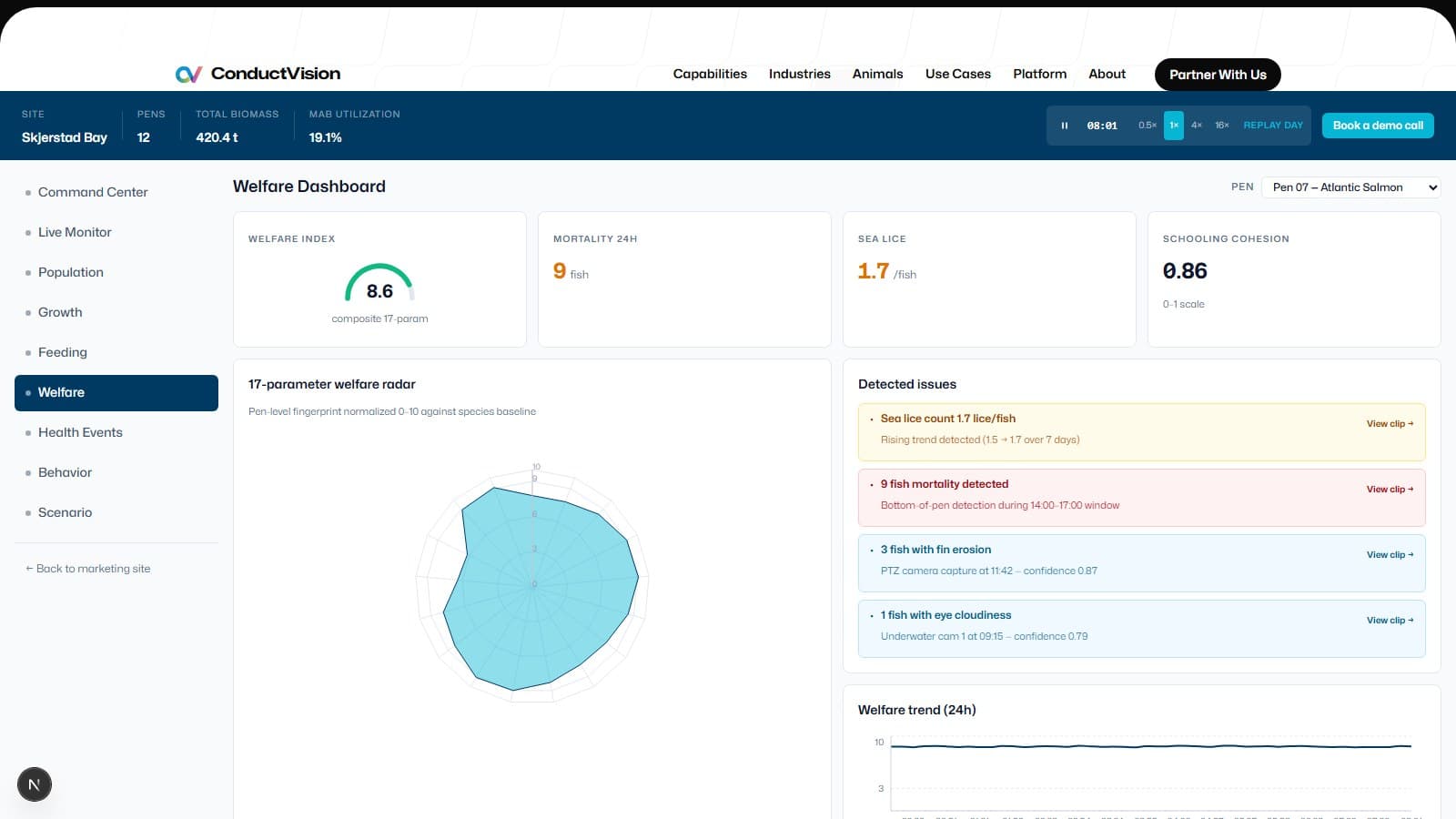
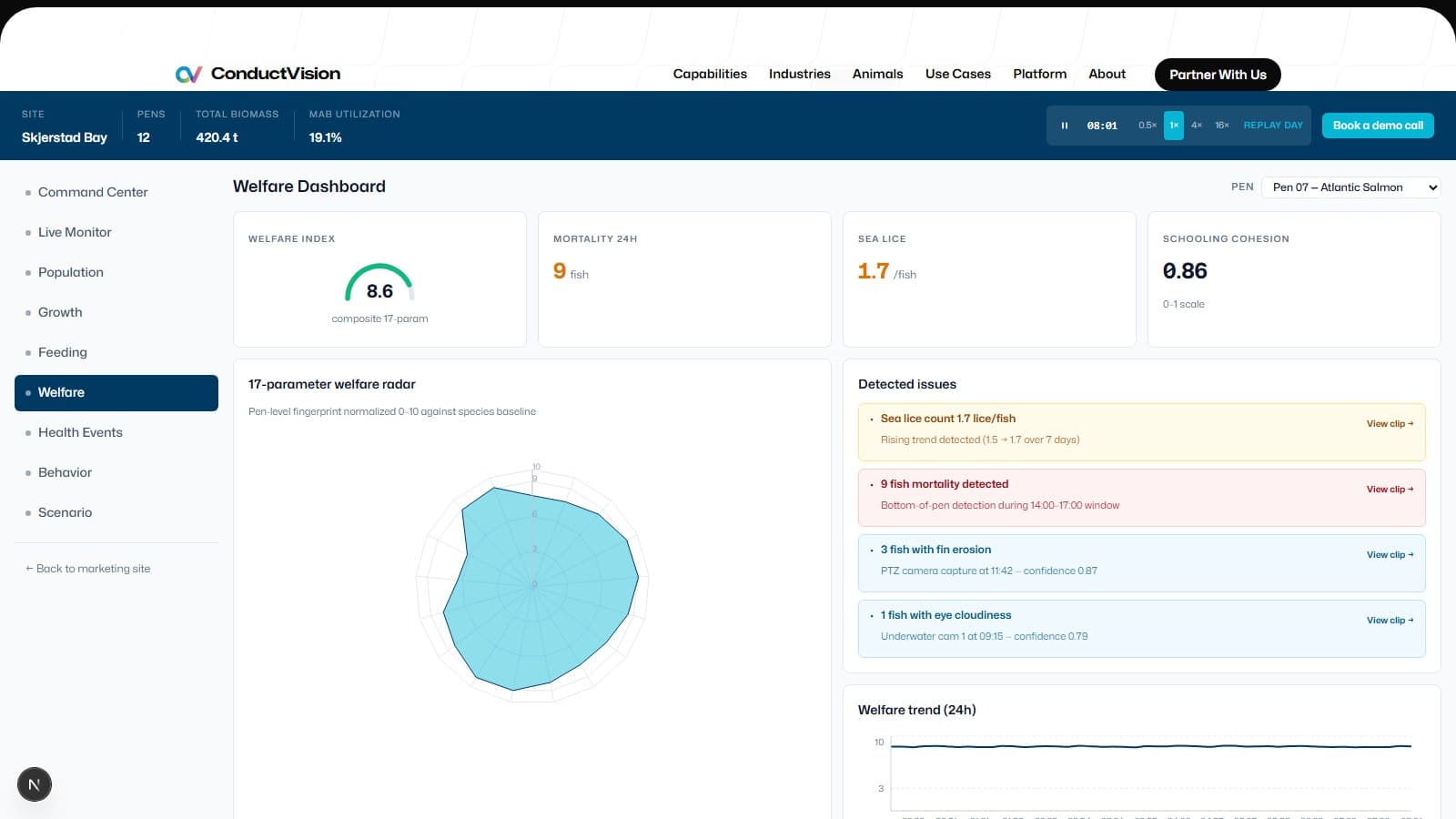
Welfare Dashboard
Per-pen welfare index with parameter breakdown and trend indicators
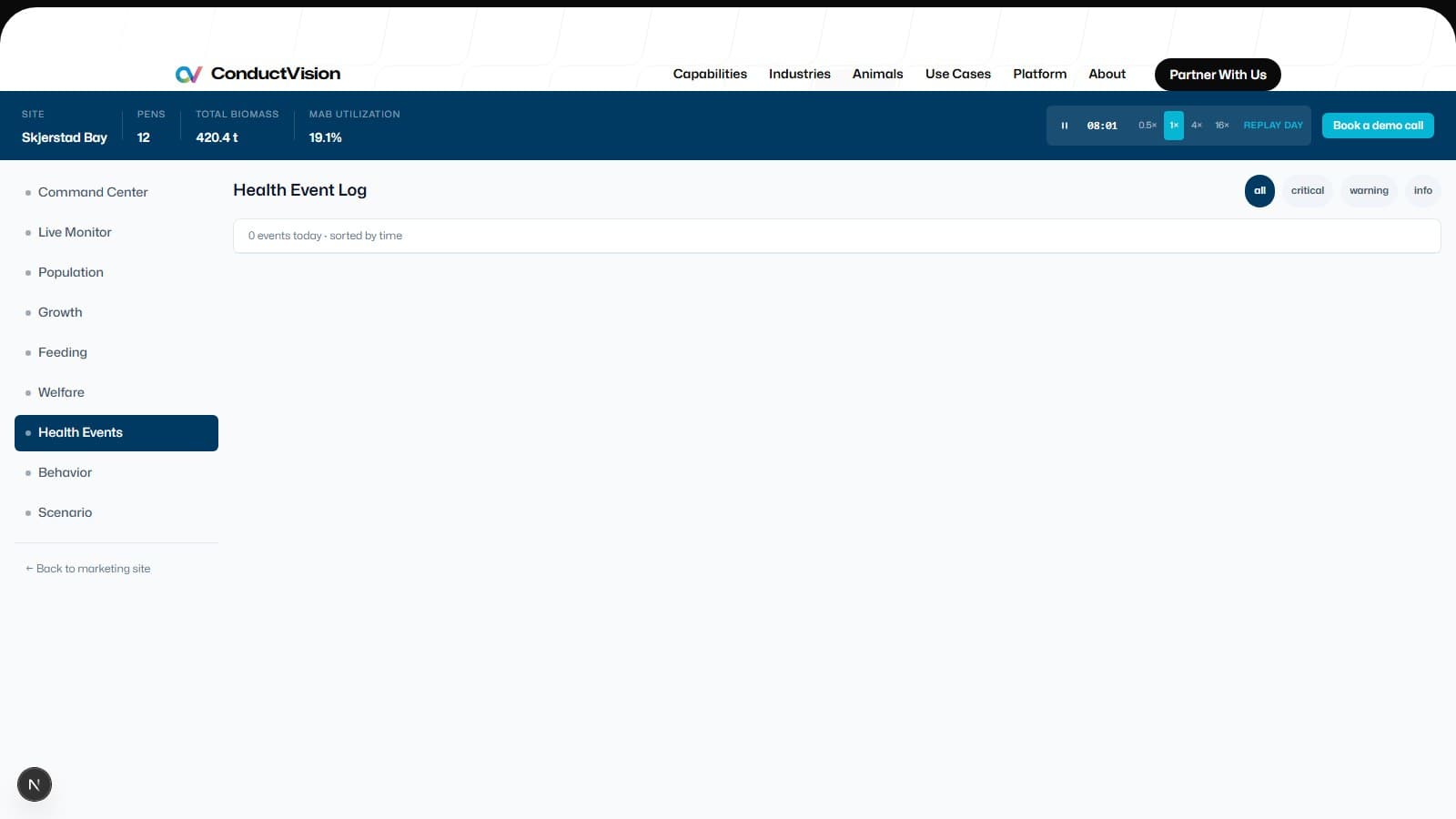
Health Event Log
Timeline of detected health events with video evidence links
Species Support - Calibrated per species.
FAQ - Health & Welfare FAQ
Can't find the answer you're looking for? Reach out to our support team.
No. ConductVision is an early warning and monitoring system. It detects visual and behavioral indicators that correlate with health issues. Always consult your aquaculture veterinarian for diagnosis and treatment decisions.
Dead fish on the surface or bottom are typically detected within 2 minutes of entering the camera field of view. Alerts are sent immediately with camera evidence.
Yes. The system detects visible sea lice on individual fish during close-pass camera observations. Detection accuracy depends on camera resolution and proximity — higher resolution cameras yield better parasite detection.
Manual scoring requires handling fish, is subjective, and samples a tiny fraction of the population. ConductVision scores every fish that passes the camera, uses standardized criteria, and provides continuous monitoring rather than point-in-time snapshots.
Still have questions? We are happy to talk it through.
Explore - Other aquaculture capabilities.
Ready to get started?
Book a demo to see health & welfare intelligence in action for your operation.