
Fabric defect · Dyeing and printing - Crease marks and rope marks: causes and how they count
A crease mark is a line set into the fabric where it was folded or pressed. Rope marks are long, irregular marks from wet processing, where fabric can travel as a twisted strand, or rope. Creases can start at the loom, in rolling or in wet processing, and a resin finish can set them for good.
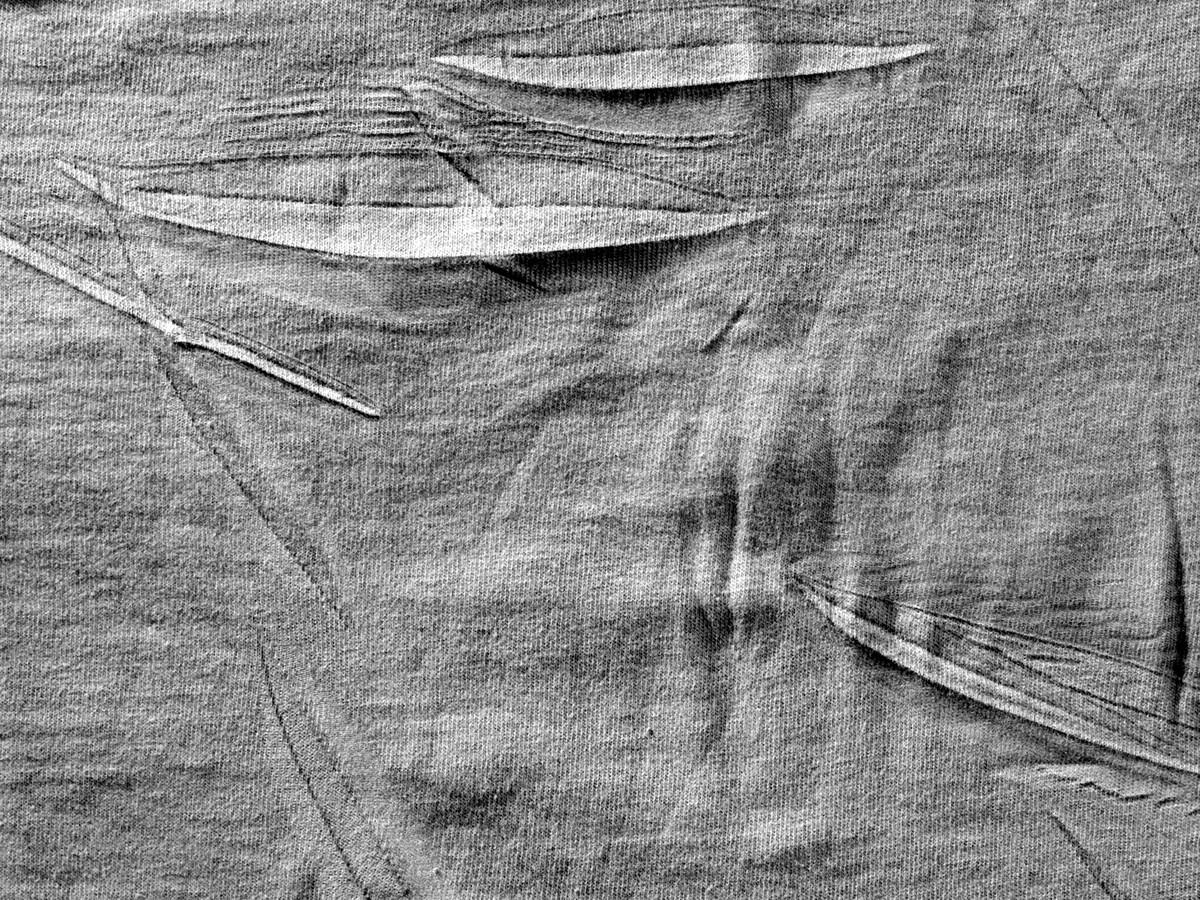
What ConductVision Textile records
ConductVision Textile is designed to flag each defect with its place on the roll, its size, its points and a still image. Your inspector names the defect and confirms or dismisses it.
On the defect map in the roll report, a crease mark is an irregular line.
What crease marks are
A U.S. military glossary of knitting imperfections defines a crease as "a set line or mark usually made by folding and/or pressing" 1. A U.S. federal glossary of fabric imperfections lists crease, mill wrinkle and hard crease together as one finishing imperfection. It defines rope marks as "long irregular indistinct markings on dyed or finished goods" and crowsfeet as "short indistinct markings on dyed or finished goods" 2. In jet dyeing and in a beck, the fabric moves in rope form 3.
In knit fabric, a university module describes crease marks as "dark haphazard broken or continuous lines" 4. A crease can turn into a dye fault at more than one step. In certain constructions, Goldberg notes, greige creases "are impossible to remove in wet processing and they show up as dye streaks" 5, and creased fabric that passes through squeeze rolls in dyeing leaves a crease streak even after the crease itself is removed 6.
Some marks that look like handling damage come from the cloth itself. Goldberg describes a taffeta that showed light streaks wherever it was crushed or rubbed with a fingernail. Its construction was to blame: filling dyed much lighter than the warp showed through unevenly where the warp shifted 5.
| Stage | What happens | What to check |
|---|---|---|
| Weaving | Careless take-up on the loom, or tight selvedges, put hard creases in the greige 5. | Take-up, and selvedge tension |
| Inspection and rolling | Re-rolling without proper spreader bars, or jerky unrolling and re-rolling 5. On knit tubes, wrinkles and folds left in the flat tube can become permanent creases 7. | Spreader bars, and a flat tube kept open |
| Jet dyeing | A plaiter that moves side to side too fast stretches and tightens the rope and can leave rope marks. Loading too fast for the goods to wet out and relax in the width can form creases, folds, crow's feet and rope marks 7. | Plaiter speed, loading slower than the dyeing speed, and surfactant and lubricant in the jet before loading |
| Extraction | Damp fabric spins fast in twisted form in a hydro extractor, a centrifuge 4, or a twisted knit tube is squeezed in rope form by the pad mangle, which "results in distinct linear folds and creases, which are often permanent" 7. | Detwisting before extraction, and fabric loaded loose and open, not in rope form |
| Extraction | Rolls whose hardness does not suit the fabric leave crease lines, and pushing water extraction too far can crease the edges of tubular knits 7. | Roll hardness matched to the fabric, and the extraction level |
| Dyeing | Creased fabric passing through squeeze rolls leaves a crease streak, even after the crease itself is removed 6. | Fabric entering squeeze rolls flat |
| Dyeing | Flat goods such as satins, taffetas and twills need the open width "to avoid streaks and creases" 5. | Open-width handling on jigs, continuous ranges or padders |
| Compacting | In compacting, a finishing step that shortens the fabric to cut length shrinkage, wrinkles on the folded edge of a flat knit tube can be pressed into hard creases 3, 6. | The flat tube and its folded edges going into the compactor |
| Resin finishing | Creases made before a resin finish is applied or cured are set permanently, and cannot be removed unless the resin is removed chemically 5. | That fabric is flat before resin is applied and cured |
| Roll-up | An operator does not fit the fabric properly to the tube in the final roll-up 6. | Roll-up on the tube |
Where crease marks show on a roll
On tubular knits, look along the folded edges. Tubular fabric can be "very sensitive to distinct edge lines being formed" in extraction 7, and in one example a compactor pressed wrinkles on the folded edge into hard creases 6. In woven cloth, a folded or doubled selvedge in finishing leaves a "more or less regular mark in the finished cloth along the selvage" 2.
Rope marks are long and irregular, and crowsfeet short 2. Knit crease marks can be broken or continuous 4.
How crease marks count
One buyer manual, which follows the 4-point system of ASTM D5430, lists creasing among continuous defects, with uneven finish and barre, and gives up to 4 points to each linear yard or metre that has one. No linear yard or metre gets more than 4 points 8. A short crease is scored by its length: 1 point up to 3 inches, 2 points over 3 up to 6 inches, 3 points over 6 up to 9 inches and 4 points over 9 inches 9.
Cotton Incorporated's defect glossary rates its crease streak, roll-up crease and compactor crease examples as major finishing defects 6. Its grading guide defines a major defect as one severe enough, if exposed, to make the end item a second 10.
What research says
A suit jacket had irregular creases that no pressing would remove, wet, dry or with a steam iron. Its fabric carried a resin crease-resistant finish. Once the resin was stripped from a cutting in the laboratory, ordinary hand ironing took the creases out. Goldberg concluded that the creases were in the goods just before the resin was applied and cured, and the resin set them 5.
In a satin slip-cover fabric, short warpwise creases started at filling changes. Tests showed the nylon filling varied in how it stretched, and Goldberg put the creases down to yarn that had not been as fully shrunk, or "relaxed," as the rest 5.
Sources
- 1U.S. Department of Defense, MIL-STD-1491, Glossary of Knitting Imperfections (1971)
- 2U.S. General Services Administration, Federal Standard No. 4b, Glossary of Fabric Imperfections (1964)
- 3Cotton Incorporated, Textile Glossary
- 4S. Natarajan, Knitted fabric defects, chapter 17 of Textile Manufacturing and Testing, e-PG Pathshala, INFLIBNET
- 5J. B. Goldberg, Fabric Defects: Case Histories of Imperfections in Woven Cotton and Rayon Fabrics, McGraw-Hill (1950)
- 6Cotton Incorporated, Standard Fabric Defect Glossary
- 7Cotton Incorporated, Wet Processing of 100 Percent Cotton Knitted Fabrics, Technical Bulletin TRI 3011 (1999)
- 8DXLG Fabric Inspection Guidelines, version 1.1
- 9P. Joshi and A. Trivedi, Fabric Inspection System and Machines, Fibre2Fashion
- 10Cotton Incorporated, Visual Inspection and Grading of Fabrics
Pilot - How a pilot starts
We start with recorded video of your inspection frame and agree with your team on one fabric to test. The pilot runs for a set time, and before it starts we agree on what counts as success. For each defect it marks, ConductVision saves a still image and its place on the roll on your network for your inspector to check.
- You bring
- Recorded video of fabric running over your inspection frame
- We set up
- One fabric, and the limit you grade it against
- You get
- Marked defects, running points and a final points forecast for each roll, and a results report checked against what we agreed
One question to start with
Which fabric shows crease marks most often?
Related pages
- Dye spots and chemical stainsA spot of unwanted color, or a stain left by a chemical, from dyeing or finishing.
- Oil stains and grease spotsMachine oil or grease on the fabric, or worked into its yarn.
- Defect positionWhat a defect's place on the roll points to
- Defect sizeHow a defect's length sets its points
- Fabric defect libraryWoven, knit and yarn defects, and how they are measured