
Fabric defect · Knit fabric - Barre defect in knit fabric
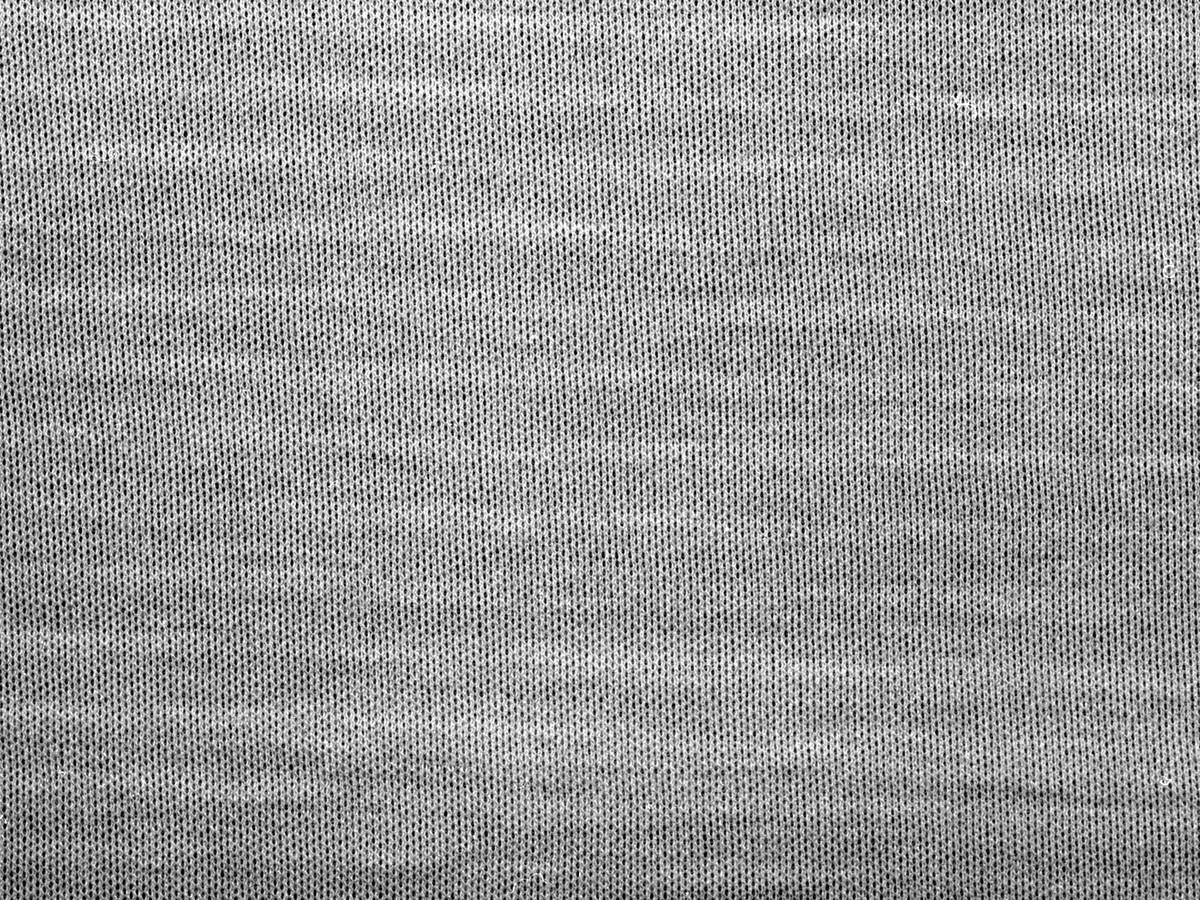
Barre is a repeating pattern of bars or stripes across knit fabric, usually along the courses of circular knits. The bars come from differences in the yarn or in how it was knitted.
What ConductVision Textile records
ConductVision Textile is designed to flag each defect with its place on the roll, its size, its points and a still image. Your inspector names the defect and confirms or dismisses it.
On the defect map in the roll report, barre shows as bands across the width, often at an even spacing.
What barre is
Cotton Incorporated defines barre as "an unintentional, repetitive visual pattern of continuous bars and stripes usually parallel to the filling of woven fabric or to the courses of circular knit fabric" 1. In a warp knit it runs along the length instead, following the yarn 1.
A streak can be one course wide or several, a shadow band. It can come from physical, optical or dye differences in the yarns, from geometric differences in the fabric's structure, or from any combination of these 1.
Woven fabric has its own filling barre, a cluster of streaks in the filling direction with normal filling between them 2. Woven bands are covered on the filling bars page.
What causes barre
Cotton Incorporated sums up the causes in one word, inconsistency, and lists them at every stage from the fiber to the scour 1.
| Stage | What happens | What to check |
|---|---|---|
| Fiber | Micronaire that is not controlled between laydowns or varies too much within one, and fiber color that is not controlled 1. | Bale laydown and micronaire control |
| Yarn | Mixing yarns of different counts, spinning systems, blend levels or suppliers, or with a different twist, hairiness or wax 1. | Yarn lots, labels and suppliers on each machine |
| Knitting | The wrong stitch length or tension at a feed, take-down that varies from loose to tight, needles at uneven heights, or a double feed end 1. | Stitch length and tension at each feed, take-down and needles |
| Knitting | Worn needles, which "generally produce length direction streaks" rather than bars across 1. | Needles, when the streaks run lengthwise |
| Scouring | Spinning or knitting oil and wax that scouring did not remove evenly leave streaks that glow under ultraviolet light 1. | Oil and wax, under ultraviolet light |
Where barre shows on a roll
Barre repeats; that is part of its definition. Cotton Incorporated has the analyst record how often the bars come and which way they run, whether they are dark or light, and the total length of the pattern repeat 1. On a single jersey machine, one turn knits a course for each feed of yarn 3, so a fault at one feed comes back once a turn, after as many courses as the machine has feeds.
A streak along the length points elsewhere: Cotton Incorporated links worn needles to streaks in the length direction 1.
How barre counts
Barre is a continuous defect. One buyer manual, which follows the 4-point system of ASTM D5430, lists it among continuous defects, with uneven finish, and gives up to 4 points to each yard or metre that has one. No linear yard or metre gets more than 4 points, however many defects it holds 4. Barre down the length of a roll can cost 4 points in every yard, and a buyer can set a stricter rule.
Cotton Incorporated notes that dyeing to a very dark or very light shade can mask barre 1.
What research says
Cotton Incorporated's bulletin sets out how a lab separates the causes: viewing the fabric flat, on both sides, under fluorescent and ultraviolet light; an instrument that isolates barre caused by physical differences; taking the fabric apart; microscopy; and a tester for knitting tension 1.
To prevent barre, the bulletin asks for consistency: labelled stock yarn, fugitive tints to tell yarn lots apart, first-in, first-out use of yarn, well-kept machines, and sample dyeings before full production 1.
Sources
- 1Cotton Incorporated, Barré, Technical Bulletin TRI 1002 (1992)
- 2J. B. Goldberg, Fabric Defects: Case Histories of Imperfections in Woven Cotton and Rayon Fabrics, McGraw-Hill (1950)
- 3Cotton Incorporated, Knit Fabrics and the Reduction of Torque, Technical Bulletin TRI 2002 (2001)
- 4DXLG Fabric Inspection Guidelines, version 1.1
Pilot - How a pilot starts
We start with recorded video of your inspection frame and agree with your team on one fabric to test. The pilot runs for a set time, and before it starts we agree on what counts as success. For each defect it marks, ConductVision saves a still image and its place on the roll on your network for your inspector to check.
- You bring
- Recorded video of fabric running over your inspection frame
- We set up
- One fabric, and the limit you grade it against
- You get
- Marked defects, running points and a final points forecast for each roll, and a results report checked against what we agreed
One question to start with
Which knit fabric shows barre most often?