
Fabric defect · Woven fabric - Filling bars and weft bars in fabric
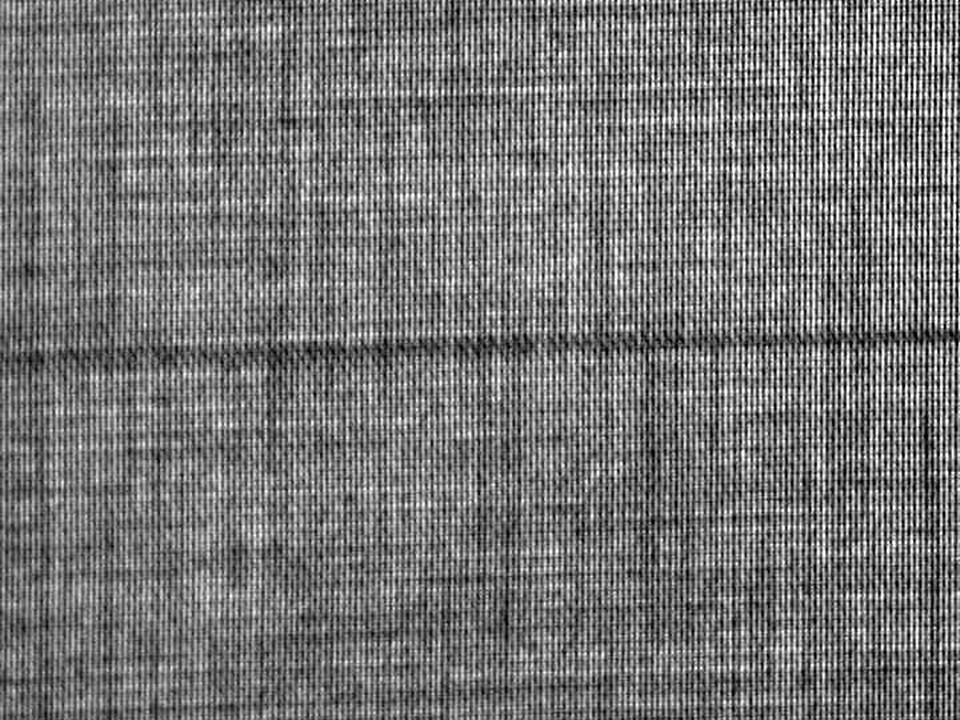
A filling bar is a band across woven fabric where the picks differ from the rest: thicker or thinner, more or fewer, darker or lighter. It can be a narrow bar or a band several inches long. It comes from the filling yarn or from how the loom laid it in, and some bars show only after dyeing.
What ConductVision Textile records
ConductVision Textile is designed to flag each defect with its place on the roll, its size, its points and a still image. Your inspector names the defect and confirms or dismisses it.
On the defect map in the roll report, a filling bar crosses the width, so its place along the roll marks where the band starts.
What filling bars are
A U.S. federal glossary of fabric imperfections defines the heavy filling bar as "a fillingwise band or bar either across the full width of the cloth or a portion of it," with picks thicker than normal or more of them, and the light filling bar as the same band with finer picks or fewer of them 1. Filling that differs from the rest, such as the wrong twist, color or yarn lot, it calls mixed filling or a shade bar 1.
Goldberg's 1950 casebook calls a wide band a filling band, "generally at least several inches in width with a different appearance in shade or luster," sometimes one or more whole bobbins of yarn 2. A filling change is a band that starts at a knot or a filling-bobbin transfer and gradually fades 2.
Some bars hide in the greige goods. Goldberg notes that uneven pickage is not always easy to see before dyeing; once the goods are dyed and finished, the dye penetrates unevenly and narrow bands show where the fabric is denser 2.
What causes filling bars
| Stage | What happens | What to check |
|---|---|---|
| Yarn | Full bobbins of mixed filling give complete bands of a different look or color, from one shuttle change to the next 2. | Yarn lots and bobbins at the loom |
| Yarn | Stretched yarn, tint left in the yarn, and yarn uneven in size or twist give short filling streaks 2. | Yarn size, twist and tint |
| Weaving | Take-up rolls that run untrue, a faulty take-up motion or a let-off motion out of adjustment give uneven pickage 2. | Take-up and let-off |
| Loom stops | While a loom stands, the warp and cloth creep and relax and the cloth fell moves, so the first picks after the restart beat up too sparse or too dense 3. | Long stops, and fine or stretchy yarn |
| Warp tension | Warp tension that swings as the loom runs, set up by the movement of the tension rollers 4. | Warp tension and the back rollers |
Where filling bars show on a roll
A filling bar runs across the width, across all of it or part of it 1. Its place along the roll is where the yarn or the loom changed. A band of mixed filling runs from one shuttle change to the next, a filling change starts at a knot or a bobbin transfer, and a set mark sits where the loom stopped 2.
How filling bars count
A bar across the full width is longer than 9 inches, so it gets 4 points, and one buyer manual gives each full-width defect a maximum of 4. A band that runs on along the roll for more than 9 inches gets up to 4 points in each linear yard it covers, and no linear yard gets more than 4 points, however many defects it holds 5.
What research says
A 1968 analysis of warp tension on the loom proposed that thick and thin places come mainly from swings in warp tension set up by the movement of the tension rollers. It also found that tension at a start or a stop differs from steady running, which it suggested shapes set marks 4.
A 2015 conference paper traced start-up marks to the cloth fell creeping out of place while the loom stood, and found that longer stops, finer yarn and stretchier yarn moved the fell further 3.
Sources
- 1U.S. General Services Administration, Federal Standard No. 4b, Glossary of Fabric Imperfections (1964)
- 2J. B. Goldberg, Fabric Defects: Case Histories of Imperfections in Woven Cotton and Rayon Fabrics, McGraw-Hill (1950)
- 3Q. Zhou, J. Zhang, Q. Shen and G. Chen, Research on start-up mark mechanism and intelligent compensation, ICMMCCE 2015, 1568-1572
- 4N. Inui, Thick and thin places in fabrics during weaving, Part 1, Journal of the Textile Machinery Society of Japan 14(5), 143-152 (1968)
- 5DXLG Fabric Inspection Guidelines, version 1.1
Pilot - How a pilot starts
We start with recorded video of your inspection frame and agree with your team on one fabric to test. The pilot runs for a set time, and before it starts we agree on what counts as success. For each defect it marks, ConductVision saves a still image and its place on the roll on your network for your inspector to check.
- You bring
- Recorded video of fabric running over your inspection frame
- We set up
- One fabric, and the limit you grade it against
- You get
- Marked defects, running points and a final points forecast for each roll, and a results report checked against what we agreed
One question to start with
Which fabric shows filling bars most often?
Related pages
- MispicksA pick woven out of order, missing or doubled.
- BarreA repeating pattern of bars or stripes, from differences in yarn or knitting.
- SlubsA short, thick place in the yarn.
- Defect positionWhat a defect's place on the roll points to
- Defect sizeHow a defect's length sets its points
- Fabric defect libraryWoven, knit and yarn defects, and how they are measured