
Fabric defect · Knit fabric - Runs and ladders in knit fabric
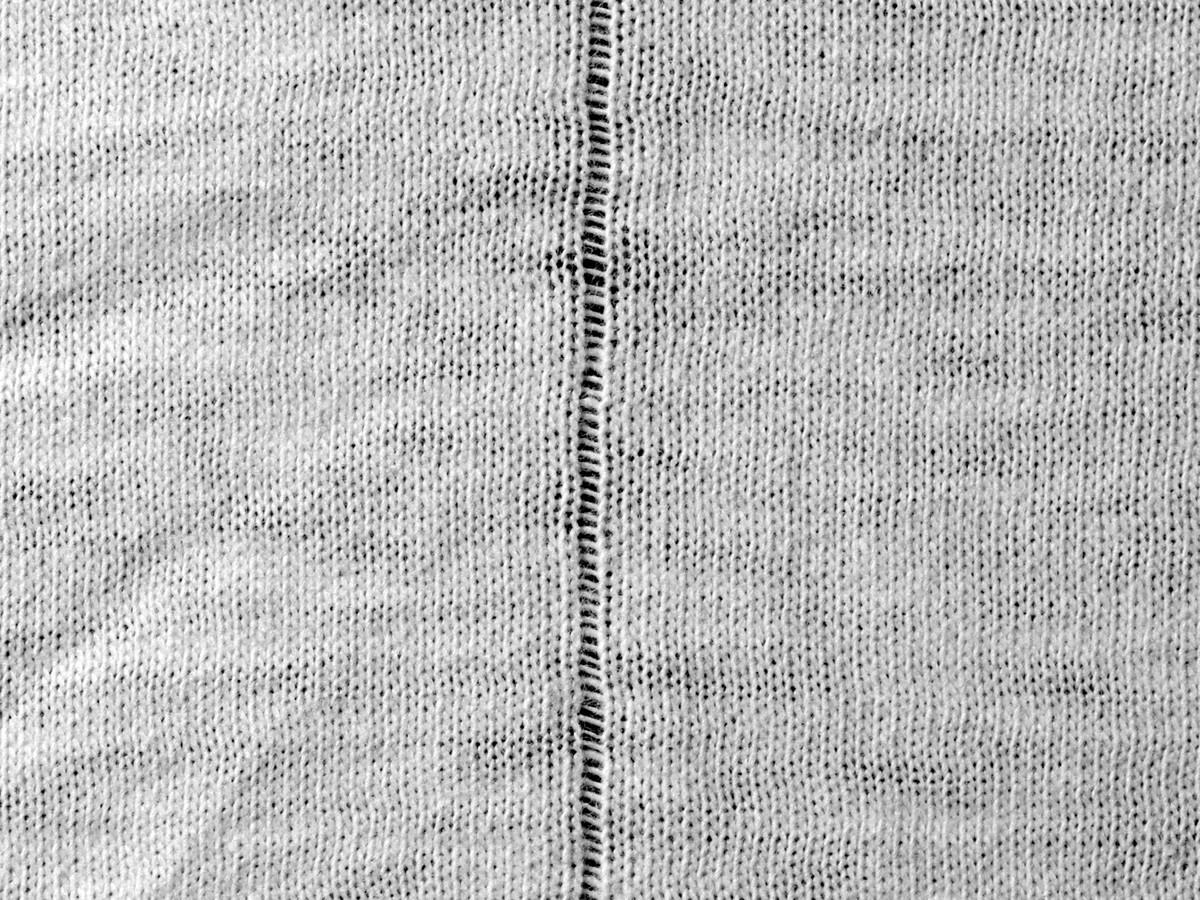
A run, or ladder, is a line of dropped stitches down one wale of knit fabric. Once a loop is free, the loops along its wale can unravel one by one, so one fault can become a long line.
What ConductVision Textile records
ConductVision Textile is designed to flag each defect with its place on the roll, its size, its points and a still image. Your inspector names the defect and confirms or dismisses it.
On the defect map in the roll report, a run is a line along the roll.
What runs and ladders are
A U.S. military glossary of knitting imperfections defines a run as "a series of dropped stitches," gives ladder as another name for it, and defines a drop stitch as "an unknitted stitch" 1. Dropped stitches are "recurrent unknitted stitches in one or more wales within a length of a knitted fabric" 1.
A university module on knit defects traces drop stitches, which it also calls runners, to a defective needle, or to yarn not laid properly into the needle hooks 2.
What causes runs
Every cause below is in knitting. A run can also start later, at a hole or a snag made in dyeing or handling, because it grows from any loop that comes free.
| Stage | What happens | What to check |
|---|---|---|
| Knitting | A defective needle drops stitches 2. | Needles |
| Knitting | Yarn is not laid into the needle hooks, because a feeder is set wrong or the yarn is too stiff and jumps away from the hook 2. | Feeder settings, yarn stiffness and even tension on every feeder |
| Knitting | Too little fabric take-down, so loops already formed can come out of the needles before the next course is knitted 2. | Fabric take-down |
| Knitting | After a drop stitch, an empty needle with a closed latch can pull the yarn out of the next needles and leave a patch of drop stitches side by side, called cloth fall-out 2. | Needle latches after any drop stitch |
Where runs show on a roll
Dropped stitches sit in one or more wales along a length of the fabric 1, so a run lies along the roll, not across it.
How runs count
A run that continues along the roll is a running defect. One buyer manual, which follows the 4-point system of ASTM D5430, gives a maximum of 4 points to each linear yard or metre that a running defect longer than 9 inches covers, and no linear yard gets more than 4 points 3. A short run is scored by its length 3. A run can keep growing, so a buyer's manual may treat runs more strictly than their length suggests.
Pilot - How a pilot starts
We start with recorded video of your inspection frame and agree with your team on one fabric to test. The pilot runs for a set time, and before it starts we agree on what counts as success. For each defect it marks, ConductVision saves a still image and its place on the roll on your network for your inspector to check.
- You bring
- Recorded video of fabric running over your inspection frame
- We set up
- One fabric, and the limit you grade it against
- You get
- Marked defects, running points and a final points forecast for each roll, and a results report checked against what we agreed
One question to start with
Which knit fabric shows runs most often?
Related pages
- HolesAn opening where yarns have broken or been cut.
- BarreA repeating pattern of bars or stripes, from differences in yarn or knitting.
- Snags and pulled threadsA yarn pulled out of place by a sharp point.
- Defect positionWhat a defect's place on the roll points to
- Fabric defect libraryWoven, knit and yarn defects, and how they are measured