
Fabric defect · Holes, threads and stains - Holes in fabric: causes and how they count
A hole is an opening where yarns in the fabric have broken or been cut. It can start at the loom or the knitting machine, in dyeing and finishing, or in handling, and the pattern holes make along a roll often shows which.
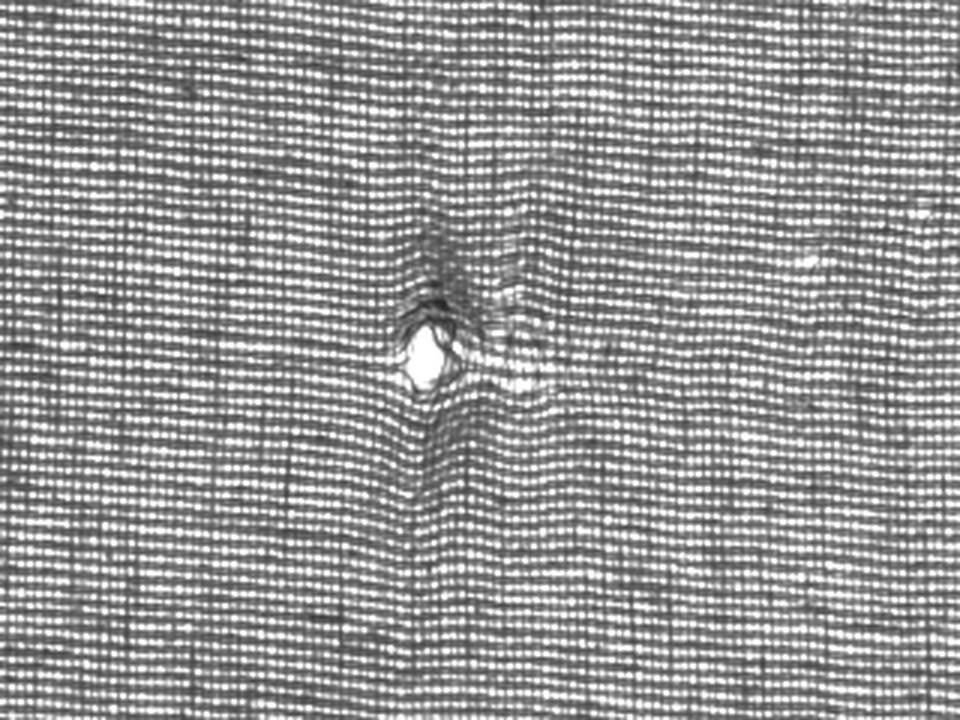
What ConductVision Textile records
ConductVision Textile is designed to flag each defect with its place on the roll, its size, its points and a still image. Your inspector names the defect and confirms or dismisses it.
On the defect map in the roll report, a hole is a spot.
What a hole is
A U.S. military glossary of knitting imperfections defines a hole as "a place in the fabric where two or more contiguous yarns have been ruptured" 1. Inspectors also speak of pinholes, cuts and tears. A cut shows sharp edges somewhere around the opening, which points to a cutting action rather than a tear 2. With light behind the fabric, a hole shows bright against the weave.
Holes turn up in woven and knit fabric. In woven fabric they can start at the loom, as the temple pins below show, and Goldberg lists many conditions that open holes once the goods are wet-processed by the dyer 2. In knit fabric a hole can come straight off the machine, from the way the yarn is fed and pulled 3.
What causes holes
| Stage | What happens | What to check |
|---|---|---|
| Weaving | Coarse or dull pins on a temple roll make small holes near one selvedge 2. | Temple rolls and their pins |
| Weaving | What a customer calls pinholes can be small open spaces left by kinky filling, from yarn that slipped off the bobbin during weaving 2. | Winding tension and room humidity |
| Singeing | At loom start-up places, where the picks are sparse, the singeing flame can shoot through the open cloth and burn small holes 2. | Start-up places in the greige goods |
| Yarn | Knots slip open, or thin places in the yarn give way when the goods are under tension, above all in rayon, which is much weaker wet 2. | Knots and thin places in the yarn |
| Finishing | Tiny cuts from too rough a sand roll or from the shear, cuts from embossing rolls, and punctures from rough wood or metal in a processing machine 2. | Sand rolls, shear blades, embossing rolls and machine surfaces |
| Dyeing and handling | Careless handling, or objects in boil-off and dyeing vessels, puncture or tear the goods 2. | Handling, and the inside of boil-off and dyeing vessels |
| Knitting | High yarn tension, yarn overfeed or underfeed, high fabric take-down force and blocked yarn paths 3. | Yarn tension and feed, take-down force and the yarn path |
| Knitting | The yarn breaks in the knitting zone as the loop forms. Where a knot is to blame, the yarn normally breaks just before it, because the knot sticks in the needle or causes a tension peak 4. | Knots in the yarn, and yarn tension |
| Processing or storage | Chemical damage, or damage by insects 2. | Chemicals used in processing, and stored goods |
Where holes show on a roll
A hole is a spot, so the pattern holes make along the roll says more than any one of them. Goldberg's first step with holes was to find how often they occur and how they are spread, because the repeat of the damage, or the lack of one, is often the clue 2.
A regular repeat points to a part on a machine. A spacing that grows or shrinks a little points to damage done while the fabric was rolled up, "the repeat being a measure of the roll circumference" 2. Small holes near one selvedge, reaching about 4 inches in from the edge, led Goldberg to the pins on a temple roll 2.
How holes count
One trade guide to the 4-point system scores a hole of 1 inch or less at 2 points and a larger one at 4 5. Buyers differ: one study of knit fabric scored any hole except a pinhole at 4 points 3. Your buyer's manual sets the rule.
Where a hole will sit in the finished product matters too. Cotton Incorporated's grading guide notes that a small defect may be acceptable in one area of a garment or home product and not in another 6. Goldberg describes pinholes from kinky filling that would not have mattered in dress goods, but the cloth went into umbrella tops, where they became a serious fault 2.
What research says
A 2020 study graded the greige knit fabric of one circular knitting mill by the 4-point system and ranked its defects by how often they appeared and by the points they cost. Holes came third by points, after gout and press-offs 3.
The authors note that catching a hole from a faulty machine setup at the start of knitting keeps more holes from reaching spreading and cutting, where they could get the entire roll rejected 3.
Goldberg read the dye at a hole's edge to date the damage. Ragged edges with poor dye penetration are "reasonably positive proof that the damage had taken place after the dyeing operation" 2.
Sources
- 1U.S. Department of Defense, MIL-STD-1491, Glossary of Knitting Imperfections (1971)
- 2J. B. Goldberg, Fabric Defects: Case Histories of Imperfections in Woven Cotton and Rayon Fabrics, McGraw-Hill (1950)
- 3A. K. M. M. Hossain and M. I. Islam, Exploring weft knit fabric defects based on their presence and quality impact: a case study, Communications in Development and Assembling of Textile Products 1(1), 57-64 (2020)
- 4S. Natarajan, Knitted fabric defects, chapter 17 of Textile Manufacturing and Testing, e-PG Pathshala, INFLIBNET
- 5P. Joshi and A. Trivedi, Fabric Inspection System and Machines, Fibre2Fashion
- 6Cotton Incorporated, Visual Inspection and Grading of Fabrics
Pilot - How a pilot starts
We start with recorded video of your inspection frame and agree with your team on one fabric to test. The pilot runs for a set time, and before it starts we agree on what counts as success. For each defect it marks, ConductVision saves a still image and its place on the roll on your network for your inspector to check.
- You bring
- Recorded video of fabric running over your inspection frame
- We set up
- One fabric, and the limit you grade it against
- You get
- Marked defects, running points and a final points forecast for each roll, and a results report checked against what we agreed
One question to start with
Which fabric shows holes most often?
Related pages
- Loose threadsA yarn end or loop lying on the face of the fabric.
- Snags and pulled threadsA yarn pulled out of place by a sharp point.
- Runs and laddersStitches that unravel down a wale.
- Defect positionWhat a defect's place on the roll points to
- Defect sizeHow a defect's length sets its points
- Fabric defect libraryWoven, knit and yarn defects, and how they are measured