
Fabric defect · Yarn - Thick and thin places in yarn and fabric
A thick place is a stretch of yarn or fabric thicker than normal; a thin place is thinner. In yarn they come from uneven spinning or the wrong yarn. In woven fabric the loom can make them too, with picks too close together or too far apart. Thin places are weak places, where yarn tends to break.
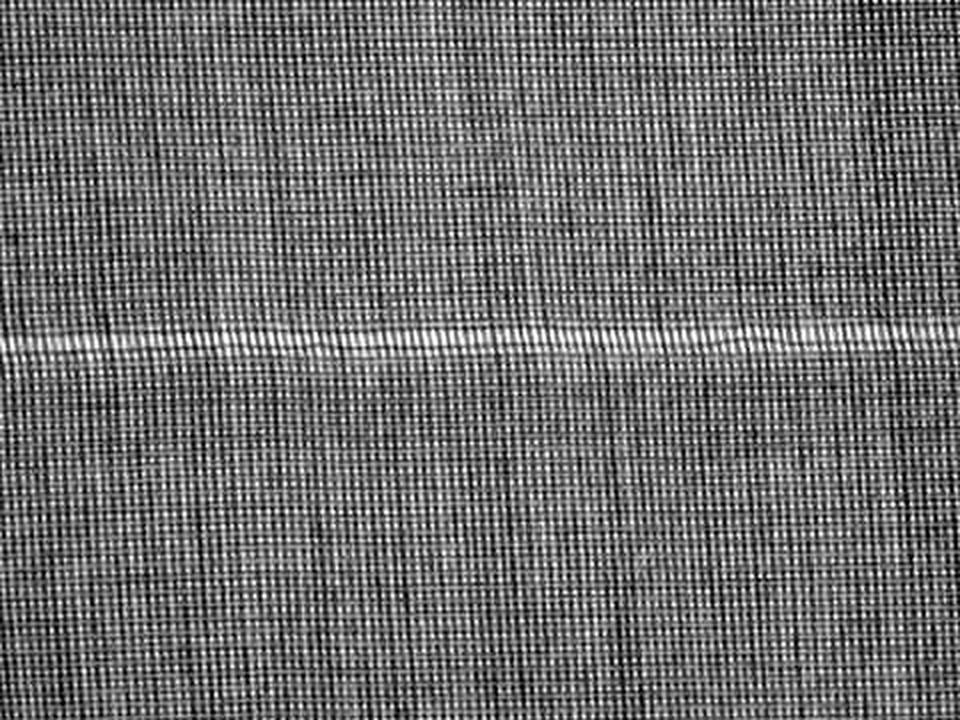
What ConductVision Textile records
ConductVision Textile is designed to flag each defect with its place on the roll, its size, its points and a still image. Your inspector names the defect and confirms or dismisses it.
On the defect map in the roll report, a thick or thin place in one yarn is a streak, and a heavy or light band from the loom is a line across the width.
What thick and thin places are
A U.S. federal glossary of fabric imperfections starts with two groups: thick places, "imperfections which cause places in the cloth to be thicker than normal," and thin places, which "cause places in the cloth to be thinner than normal" 1. A coarse pick is "a yarn larger in diameter than normally being used in the cloth," and a fine pick is "a yarn smaller in diameter than normally being used in the cloth" 1. The military glossary of knitting imperfections defines a thick place as "an area of fabric that is thicker than normal" and a thin place as "an area of fabric that is thinner than normal" 2.
Goldberg's 1950 casebook puts thick places and thin places in one family of yarn faults with slubs, neps, uneven twist and fuzziness, under the word unevenness 3. A slub is the short, abrupt kind of thick place, "an abruptly thickened place in the yarn" 1; this page covers the rest.
Thin places can show as open, weak areas. In one of Goldberg's cases, thin filling yarns were "frequently ruptured" in napping, with "open-appearing and tender areas" as the result, and the book's photograph of the thin spots was taken with light shining through the fabric 3. In another, streaks came from thick and thin places in filling yarn that varied "from as fine as 51/1 to as heavy as 37/1 within 1 yard" 3. Thickness can change the shade too: of thick-and-thin filament yarn, Goldberg notes the "tendency of the coarser filaments in the thick portions to dye much darker than the finer filaments in the thin sections" 3.
What causes thick and thin places
Thick and thin places in yarn start in spinning or in the yarn supply. In woven fabric the loom adds its own.
| Stage | What happens | What to check |
|---|---|---|
| Spinning | Faulty operation at any stage from raw cotton to spun yarn leaves uneven yarn, with thick and thin places 3. | Each stage from opening to spinning |
| Fiber | Neps in cotton lint cause short thick places in the yarn and an uneven look in the fabric 4. | Nep counts in the lint |
| Yarn supply | A poor filling yarn varied from 51/1 to 37/1 within 1 yard and left streaks in the cloth 3. | Count variation in incoming yarn |
| Filament spinning | Periodic denier, thick and thin places at regular intervals, comes from an unintended variation of the kind used on purpose to make novelty thick-and-thin yarn 3. | Denier along the yarn, with the producer |
| Filament yarn | One or two filaments wrapped in a spiral around the rest bind the yarn tight so it looks thin, for half an inch to several inches. In Goldberg's case the fault came from the yarn producer 3. | Incoming filament yarn |
| Weaving | Swings in warp tension, set up by the movement of the tension rollers, which a 1968 study proposed as the main cause of thick and thin places in woven cloth 5. | Warp tension and the tension rollers |
| Weaving | Take-up rolls that run untrue, a faulty take-up motion or a let-off out of adjustment give uneven pickage, and loom stops give set marks 3. | Take-up and let-off |
| Finishing | Napping can break thin yarns and leave open, tender areas, and thin places can give way under tension in wet processing and leave holes, especially in rayon, which is much weaker wet 3. | Yarn evenness in goods that will be napped or wet processed under tension |
Where thick and thin places show on a roll
In woven cloth a coarse or fine pick is a filling yarn, so it crosses the width, and a coarse or fine end is a warp yarn, so it runs along the roll 1. Heavy and light places made at the loom are bands "either across the full width of the cloth or a portion of it" 1. The same glossary also gives thin place as another name for a light place, and for a crack, an open streak along the filling 1. In filament filling, a denier variation of as little as 5 percent may show up as a filling band in some constructions 3.
Some repeat. The thick and thin places of periodic denier "will occur at regular intervals or periods," which gives the filling "a wavy or chattery appearance in a somewhat regular pattern" 3. Others are spread through the goods: thin, weak spots "scattered through several pieces," or thin places from wrapped filaments "at frequent intervals throughout the piece" 3.
How thick and thin places count
Thick and thin places are scored by their length: 1 point up to 3 inches, 2 points over 3 up to 6 inches, 3 points over 6 up to 9 inches and 4 points over 9 inches 6. A heavy or light band across the full width is longer than 9 inches, so it scores 4 points. A coarse end that continues along the roll is a running defect. One buyer manual, which follows the 4-point system of ASTM D5430, gives up to 4 points to each linear yard or metre in which a continuous running defect exceeds 9 inches, and no linear yard gets more than 4 points 7.
For military contract cloth, U.S. specifications score coarse yarn only when it is clearly coarse: "only coarse yarns that exceed twice the normal diameter shall be scored" 8, 9. For knits, a 2019 military standard scores "coarse or fine yarns resulting in noticeable difference in appearance stiffness and thickness" at 4 points for each yard in which they occur 9.
What research says
A 2013 study tested thin places in ring spun yarns, places with 30, 40 and 50 percent less mass than the mean mass of the yarn. As the mass fell, the local twist rose, and the breaking load and breaking extension fell 10.
A thin place has fewer fibers and more twist, which should bind them tighter, yet yarn generally breaks at a thin place: in the study, about 80 percent of the breaks came at a thin region 10. The authors argue that thin places should be kept to a minimum, for lower cost and smoother processing after spinning 10.
Sources
- 1U.S. General Services Administration, Federal Standard No. 4b, Glossary of Fabric Imperfections (1964)
- 2U.S. Department of Defense, MIL-STD-1491, Glossary of Knitting Imperfections (1971)
- 3J. B. Goldberg, Fabric Defects: Case Histories of Imperfections in Woven Cotton and Rayon Fabrics, McGraw-Hill (1950)
- 4G. Ozcelik, E. Kirtay and I. M. Derici, Examination of fiber neps count during yarn manufacturing, Beltwide Cotton Conferences (2005)
- 5N. Inui, Thick and thin places in fabrics during weaving, Part 1, Journal of the Textile Machinery Society of Japan 14(5), 143-152 (1968)
- 6P. Joshi and A. Trivedi, Fabric Inspection System and Machines, Fibre2Fashion
- 7DXLG Fabric Inspection Guidelines, version 1.1
- 8U.S. Department of Defense, MIL-DTL-44436B, Cloth, Wind Resistant Poplin, Nylon/Cotton Blend (2012)
- 9U.S. Department of Defense, MIL-STD-3064, Evaluation of Quality of Textile Materials (2019)
- 10S. K. Sinha and P. Kumar, An investigation of the behavior of thin places in ring spun yarns, Journal of Textile and Apparel, Technology and Management 8(2) (2013)
Pilot - How a pilot starts
We start with recorded video of your inspection frame and agree with your team on one fabric to test. The pilot runs for a set time, and before it starts we agree on what counts as success. For each defect it marks, ConductVision saves a still image and its place on the roll on your network for your inspector to check.
- You bring
- Recorded video of fabric running over your inspection frame
- We set up
- One fabric, and the limit you grade it against
- You get
- Marked defects, running points and a final points forecast for each roll, and a results report checked against what we agreed
One question to start with
Which yarn or fabric shows thick and thin places most often?
Related pages
- SlubsA short, thick place in the yarn.
- NepsSmall tangles of fiber that show as specks, often white ones after dyeing.
- Starting marksA band across the fabric where the loom stopped and started again.
- Filling barsPicks that differ from the rest in thickness, number or yarn.
- Defect positionWhat a defect's place on the roll points to
- Fabric defect libraryWoven, knit and yarn defects, and how they are measured