
Fabric defect · Yarn - Slub defects in yarn and fabric
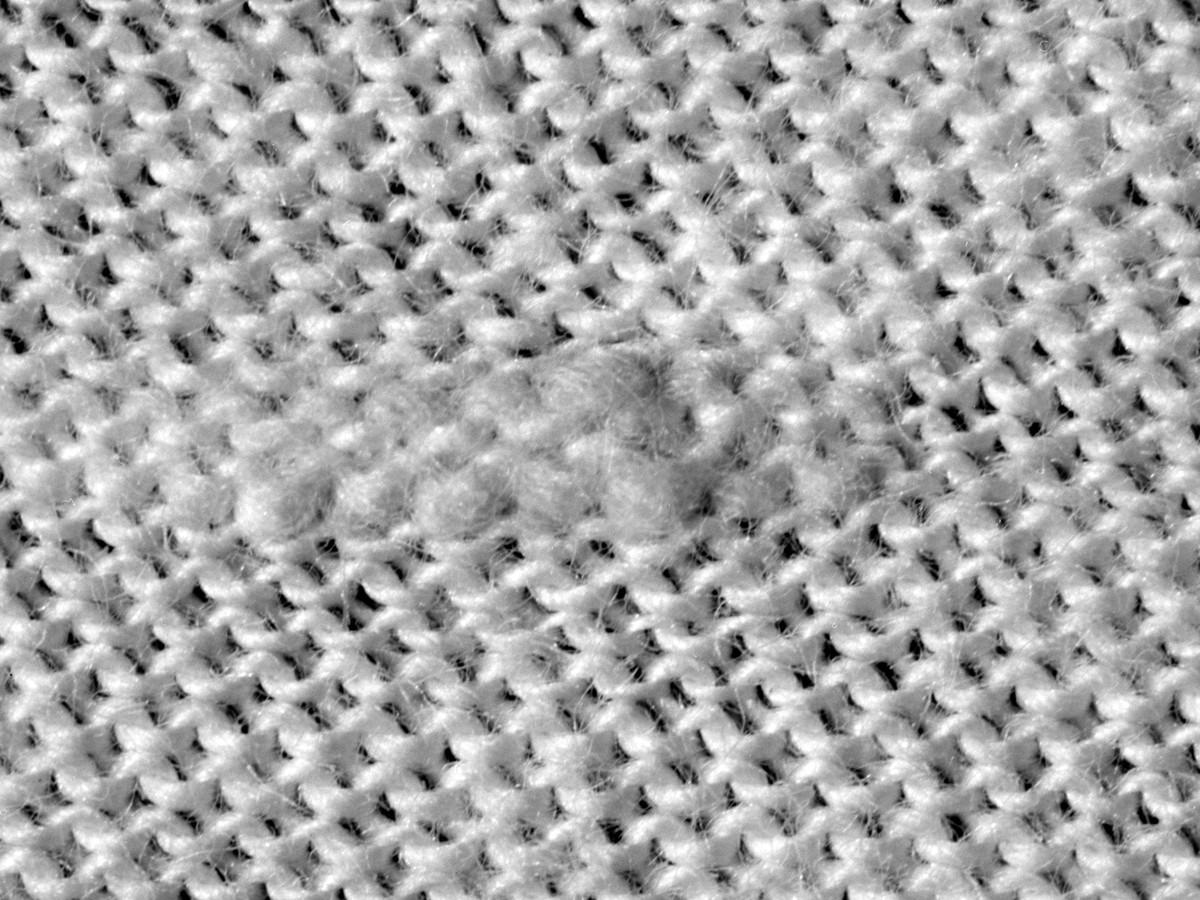
A slub is a short, thick place in a yarn. Woven or knitted into fabric, it shows as a lump along one yarn.
What ConductVision Textile records
ConductVision Textile is designed to flag each defect with its place on the roll, its size, its points and a still image. Your inspector names the defect and confirms or dismisses it.
On the defect map in the roll report, a slub is a spot.
What a slub is
Goldberg's 1950 casebook defines slubs as "thick places in spun yarns" 1. A U.S. federal glossary lists slub, slug, bunch and lump as one imperfection, "an abruptly thickened place in the yarn" 2, and the military glossary of knitting imperfections adds "a bunch of lint entangled in the yarn or fabric" 3.
Slubs belong to a wider family of yarn faults. Goldberg groups thick places, thin places, slubs, neps, uneven twist and fuzziness under one word, unevenness 1.
What causes slubs
| Stage | What happens | What to check |
|---|---|---|
| Spinning | Faulty operation at any stage from raw cotton to spun yarn leaves uneven yarn, of which slubs are one form 1. | Each stage from opening to spinning |
| Fiber | Neps, small tangles of fiber in cotton lint, cause short thick places in the yarn 4. | Nep counts in the lint |
| Opening to combing | Nep counts rise in opening and cleaning, and carding and combing bring them down 4. | Nep counts after each step |
| Knitting | A bunch of lint caught in the yarn or the fabric 3. | Lint around the machines |
Where slubs show on a roll
A slub is a spot along one yarn: a warp end or a pick in woven fabric, a course in knit fabric. Neps that make short thick places also make the fabric look uneven 4.
What research says
A 2005 study followed nep counts through yarn manufacturing, step by step, and noted that neps on the face of a fabric can leave undyed or unprinted spots 4.
The opposite fault, the thin place, matters too. A 2013 study of ring spun yarn treated thin places, with fewer fibers in the cross-section, as likely weak points in the yarn 7.
Sources
- 1J. B. Goldberg, Fabric Defects: Case Histories of Imperfections in Woven Cotton and Rayon Fabrics, McGraw-Hill (1950)
- 2U.S. General Services Administration, Federal Standard No. 4b, Glossary of Fabric Imperfections (1964)
- 3U.S. Department of Defense, MIL-STD-1491, Glossary of Knitting Imperfections (1971)
- 4G. Ozcelik, E. Kirtay and I. M. Derici, Examination of fiber neps count during yarn manufacturing, Beltwide Cotton Conferences (2005)
- 5DXLG Fabric Inspection Guidelines, version 1.1
- 6Cotton Incorporated, Visual Inspection and Grading of Fabrics
- 7S. K. Sinha and P. Kumar, An investigation of the behavior of thin places in ring spun yarns, Journal of Textile and Apparel, Technology and Management 8(2) (2013)
Pilot - How a pilot starts
We start with recorded video of your inspection frame and agree with your team on one fabric to test. The pilot runs for a set time, and before it starts we agree on what counts as success. For each defect it marks, ConductVision saves a still image and its place on the roll on your network for your inspector to check.
- You bring
- Recorded video of fabric running over your inspection frame
- We set up
- One fabric, and the limit you grade it against
- You get
- Marked defects, running points and a final points forecast for each roll, and a results report checked against what we agreed
One question to start with
Which yarn or fabric shows slubs most often?
Related pages
- Filling barsPicks that differ from the rest in thickness, number or yarn.
- Loose threadsA yarn end or loop lying on the face of the fabric.
- HolesAn opening where yarns have broken or been cut.
- Defect positionWhat a defect's place on the roll points to
- Fabric defect libraryWoven, knit and yarn defects, and how they are measured