
Fabric defect · Woven fabric - Broken ends and ends out
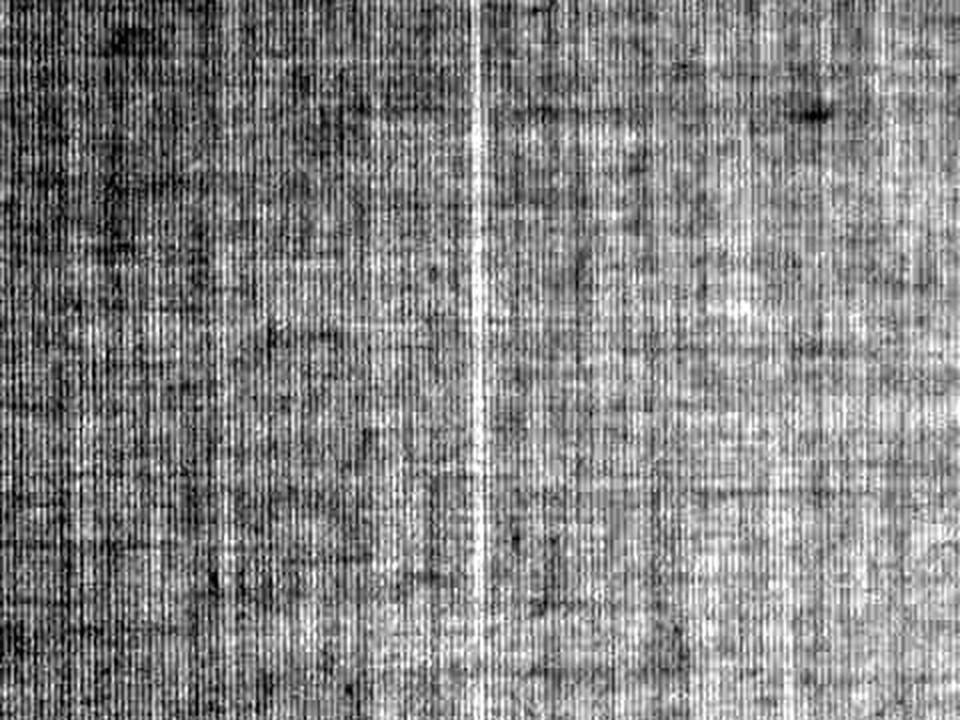
A broken end is a warp yarn that breaks during weaving. An end out is a warp yarn missing from the cloth, for part of its length or all of it, and one cause is a loom that runs on after an end breaks. An end out leaves a thin line along the length of the fabric.
What ConductVision Textile records
ConductVision Textile is designed to flag each defect with its place on the roll, its size, its points and a still image. Your inspector names the defect and confirms or dismisses it.
On the defect map in the roll report, an end out is a line along the length of the roll.
What broken ends and ends out are
A U.S. federal glossary of fabric imperfections defines a broken or missing end, or end out, as "a warp yarn missing for a portion or the entire length of the cloth." It files the fault under thin places, "imperfections which cause places in the cloth to be thinner than normal," and gives the same definition for woven cotton and woven synthetic fabric 1.
In a denim sample, Cotton Incorporated describes an end out as "a thin dark line on the face of the fabric with short filling floats on the back," and the ladder of floats on the back is the quick way to identify it. In a plain weave, the ends on either side of the gap can come together and weave as one, so the fault shows as a thin place and a double end 2.
A break that is mended leaves marks of its own. Goldberg notes that broken ends lower weaving efficiency and leave excessive knots 3. Cotton Incorporated shows a broken end whose spare yarn was woven in across the fabric, which the weaver should have cleaned up when the end was repaired 2.
What causes broken ends
Warp yarns break from repeated stretching, rubbing and bending on the loom, and more often when sizing goes wrong 4.
| Stage | What happens | What to check |
|---|---|---|
| Spinning and winding | Yarn faults break often on the loom. Some short thick faults stay weaker, stretch less and resist rubbing poorly even after sizing, and they cause warp breaks 5. | Faults in the yarn, and yarn clearing at winding |
| Sizing | With too little size the yarn is left uncovered and breaks often. Past the best add-on, breaks rise again because the yarn stretches less and grows stiffer 5. Goldberg traces excessive end breakage, among other faults, to poor warp sizing 3. | Size add-on against its target |
| Sizing | Size that coats the yarn without soaking in is stiff and sheds when the yarn rubs, and weaving suffers 5. In a 2022 mill trial, faster sizing and higher squeeze roller pressure both raised warp breaks 4. | Size penetration, sizing speed and squeeze roller pressure |
| Weaving | Warp yarns rub on the back rest, heald eyes and reed, and against each other as the shed opens and closes 5. In filament rayon warps, chafed filaments roll up into fuzz balls that gather in the reed or drop wires and cause loom stops and end breakage 3. | Back rest, heald eyes, reed and drop wires for rough or worn spots |
| Weaving | An end out is left when the loom keeps running after an end breaks 2. | The warp stop motion |
| Yarn dyeing and finishing | In one of Goldberg's cases, rayon yarn that a commission dyer had dyed a second time, black, was weakened so much that those ends broke in the normal finishing of the fabric 3. | The strength of dyed yarn lots before weaving |
Where ends out show on a roll
An end out runs in the warp direction, along the length of the cloth, and can be missing for part of the length or all of it 1. Cotton Incorporated files its end outs under warp lines, or vertical lines, and puts them in its first category, narrow or fine-lined warpwise defects "of a continuous or lengthy nature" 2, 6.
A mended break shows differently. Goldberg ties broken ends to excessive knots 3, and Cotton Incorporated files a broken end with its spare yarn woven across the fabric under weft lines, or horizontal lines 2.
How ends out count
An end out that runs along the roll is a running defect. One buyer manual, which follows the 4-point system of ASTM D5430, gives a maximum of 4 points to each linear yard or metre that a running defect longer than 9 inches covers, and no linear yard gets more than 4 points 7. An end out through a whole roll can cost 4 points in every yard. A short one is scored by its length: 1 point up to 3 inches, 2 points over 3 up to 6 inches, 3 points over 6 up to 9 inches and 4 points over 9 inches 8.
Cotton Incorporated rates its end out and broken end examples as major 2. Its grading guide calls a defect major when, if exposed, it is severe enough to make the end item a second 6.
What research says
A 2022 trial in a weaving mill sized a 100 percent cotton warp at three levels of size add-on, sizing speed and squeeze roller pressure, then counted warp breaks on an air-jet loom over three days. Breaks were fewest at the middle add-on, and they rose as the sizing machine ran faster and as squeeze roller pressure went up 4.
The authors note that their add-on result follows the sizing-weaving curve 4. IIT Delhi's course notes describe that curve: breaks fall as add-on rises to its best level, then climb again as the yarn loses stretch and stiffens 5.
Sources
- 1U.S. General Services Administration, Federal Standard No. 4b, Glossary of Fabric Imperfections (1964)
- 2Cotton Incorporated, Defects Glossary, CottonWorks
- 3J. B. Goldberg, Fabric Defects: Case Histories of Imperfections in Woven Cotton and Rayon Fabrics, McGraw-Hill (1950)
- 4D. Jahangir and M. S. Hossain, Analysis of the effect of sizing add-on percent and sizing process parameters on the average warp breakage rate for 30Ne 100 percent cotton warp yarn, Journal of Engineering Science 13(2), 111-115 (2022)
- 5A. Majumdar, Fabric Manufacture I, NPTEL course notes, IIT Delhi (2009-2011)
- 6Cotton Incorporated, Visual Inspection and Grading of Fabrics
- 7DXLG Fabric Inspection Guidelines, version 1.1
- 8P. Joshi and A. Trivedi, Fabric Inspection System and Machines, Fibre2Fashion
Pilot - How a pilot starts
We start with recorded video of your inspection frame and agree with your team on one fabric to test. The pilot runs for a set time, and before it starts we agree on what counts as success. For each defect it marks, ConductVision saves a still image and its place on the roll on your network for your inspector to check.
- You bring
- Recorded video of fabric running over your inspection frame
- We set up
- One fabric, and the limit you grade it against
- You get
- Marked defects, running points and a final points forecast for each roll, and a results report checked against what we agreed
One question to start with
Which fabric shows ends out most often?
Related pages
- Reed marksA streak along the warp where the ends are spaced unevenly, most often from a damaged reed.
- MispicksA pick woven out of order, missing or doubled.
- Loose threadsA yarn end or loop lying on the face of the fabric.
- Defect positionWhat a defect's place on the roll points to
- Defect sizeHow a defect's length sets its points
- Fabric defect libraryWoven, knit and yarn defects, and how they are measured