
Fabric defect · Woven fabric - Reed marks in woven fabric
A reed mark is a streak along the warp where the ends are spaced unevenly, most often because the reed is damaged. It can run through a whole piece, and dyeing and finishing seldom remove it.
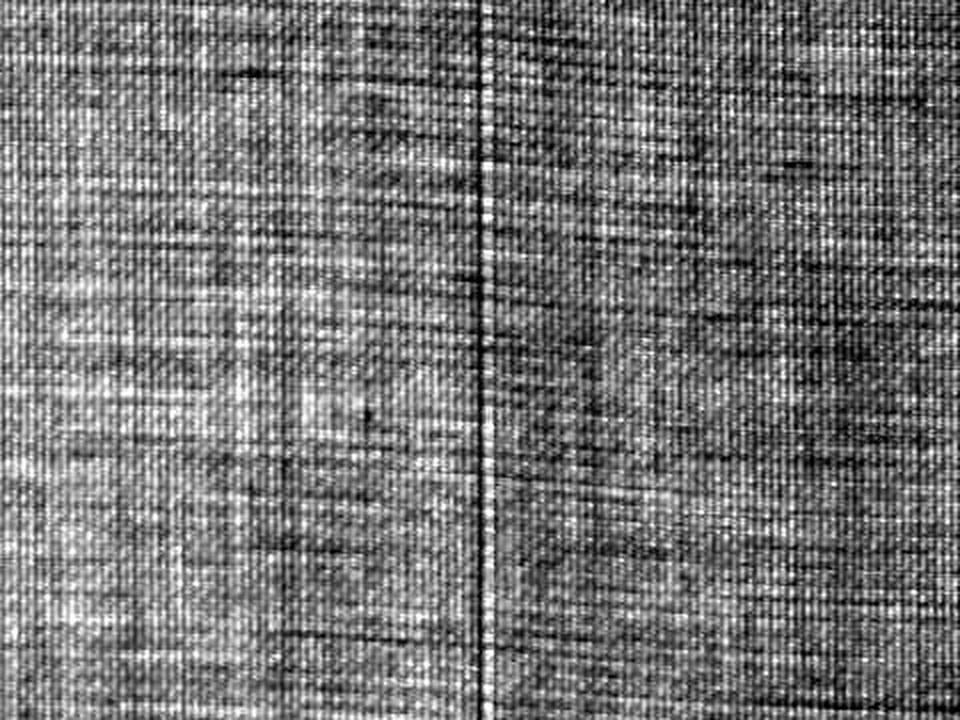
What ConductVision Textile records
ConductVision Textile is designed to flag each defect with its place on the roll, its size, its points and a still image. Your inspector names the defect and confirms or dismisses it.
On the defect map in the roll report, a reed mark is a line along the length of the roll.
What reed marks are
The reed is a comb of evenly spaced flat metal wires, and the warp ends pass through the spaces between the wires, called dents 1. A U.S. federal glossary defines a reed mark in cotton and synthetic fabric as "a mark running warpwise in the cloth," and in wool and worsted cloth as "thick or thin lines or both running warpwise in the cloth" 2. Goldberg names the usual cause: warp ends spaced unevenly by a damaged reed 1.
Mills also speak of reediness, or a reedy fabric, which spreads across the cloth instead of showing as one streak. Cotton Incorporated describes a reedy fabric as having "open streaks following the pattern of the reed wires," also called "poor cover" 3, and a teaching module on woven defects describes spacing between groups of warp ends across the width of the fabric 4. A 1982 Leeds thesis treats reediness as a matter of local thread spacing, which loom settings change 5.
A reed mark can look dark or dull. In one of Goldberg's cases a dark streak came from a cracky open place in the warp left by a damaged reed, and in another a single dull streak came from three neighbouring warp ends chafed in weaving 1. Cotton Incorporated shows an open reed, where a bent reed wire holds the warp ends apart and the filling shows through 3.
What causes reed marks
One streak points to a place in the reed or the drawing-in. Reediness across the cloth points to the reed chosen, the reed draw or the loom setting.
| Stage | What happens | What to check |
|---|---|---|
| The reed | A damaged or weak reed spaces the warp ends unevenly 1. A bent reed wire leaves a crack in the fabric 3. | Reed wires for bends and weak dents |
| The reed | Rough wire edges chafe the yarn, and tarnished or dirty reeds leave rust or grease stains. A rough dent wire, drop wire or heddle can chafe a few neighbouring ends into a dull streak 1. | Reed, drop wires and heddles for rough or rusty spots |
| Reed choice | The wrong reed, the wrong reed draw or the wrong loom setting can make a reedy fabric 3. In rayon, a high ratio of air space to wire space makes a weak reed that bends easily, and a low ratio crowds the ends so they chafe 1. | Reed count and reed draw against the fabric construction |
| Drawing in | An end drawn into the wrong dent, next to the one it belongs in, leaves a reed misdraw 3. In one of Goldberg's cases, double ends split in the reed made warp streaks in a regular pattern across the full width 1. | The drawing-in plan, dent by dent |
| Loom settings | A reedy fabric comes chiefly from late shedding 4. A balanced shed also leaves more reediness: an unbalanced shed reduces it, and in mill practice the back rail, or back rest, is raised to that end 5. | Back rail height and shed timing |
| Yarn | In a bright viscose taffeta, Goldberg put part of a streaky, "reedy" look down to the way the filaments of each warp yarn clung together and lay in the cloth, probably from rayon spinning 1. | The warp yarn itself, as well as the reed |
Where reed marks show on a roll
A reed mark runs warpwise, along the length of the cloth 2. Goldberg describes warp streaks from damaged reeds running through full pieces, a narrow streak throughout a piece, and several narrow dark streaks running the full length of a piece 1. Cotton Incorporated puts its reed faults in its first category, narrow or fine-lined warpwise defects "of a continuous or lengthy nature" 3, 6.
In one of Goldberg's cases, warp streaks in a regular pattern across the full width were traced to poor reeding, with double ends split in the reed 1. Cotton Incorporated describes reedy streaks as following the pattern of the reed wires 3.
Dyeing can bring uneven spacing out. In an acetate fabric, uneven spacing of the warp let the dye penetrate unevenly and left narrow dark streaks, which Goldberg put down to a damaged reed, weak dents or some other shift in the even spacing of the yarns 1.
How reed marks count
A reed mark that runs along the roll is a running defect. One buyer manual, which follows the 4-point system of ASTM D5430, gives a maximum of 4 points to each linear yard or metre that a running defect longer than 9 inches covers, and no linear yard gets more than 4 points 7. A reed mark through a whole piece can cost 4 points in every yard.
A faint reed mark counts the same as a strong one once it can be seen: every defect visible at normal inspection speed from one yard or one metre is counted 6, and the 4-point system scores it by its length. Cotton Incorporated rates its open reed and reedy examples as major and its reed misdraw as minor 3.
What research says
A 1982 Leeds thesis wove fabric while varying the warp tension and the balance and timing of the shed. The settings changed reediness and the air permeability that goes with it, and changed the fabric's other properties fairly little 5.
The thesis used air permeability as a gauge of reediness. Permeability fell when the shed was unbalanced, as expected, and fabric samples woven with near balanced and very unbalanced shed tensions showed the difference in reediness clearly 5.
Sources
- 1J. B. Goldberg, Fabric Defects: Case Histories of Imperfections in Woven Cotton and Rayon Fabrics, McGraw-Hill (1950)
- 2U.S. General Services Administration, Federal Standard No. 4b, Glossary of Fabric Imperfections (1964)
- 3Cotton Incorporated, Defects Glossary, CottonWorks
- 4B. A. Muralidhar, Woven fabric defects, chapter 12 of Textile Manufacturing and Testing, e-PG Pathshala, INFLIBNET
- 5A. S. M. Eldeeb, The effect of loom settings on weaving resistance and fabric properties, PhD thesis, University of Leeds (1982)
- 6Cotton Incorporated, Visual Inspection and Grading of Fabrics
- 7DXLG Fabric Inspection Guidelines, version 1.1
Pilot - How a pilot starts
We start with recorded video of your inspection frame and agree with your team on one fabric to test. The pilot runs for a set time, and before it starts we agree on what counts as success. For each defect it marks, ConductVision saves a still image and its place on the roll on your network for your inspector to check.
- You bring
- Recorded video of fabric running over your inspection frame
- We set up
- One fabric, and the limit you grade it against
- You get
- Marked defects, running points and a final points forecast for each roll, and a results report checked against what we agreed
One question to start with
Which fabric shows reed marks most often?
Related pages
- Broken endsA warp yarn that breaks, or is missing for part or all of the cloth.
- MispicksA pick woven out of order, missing or doubled.
- Filling barsPicks that differ from the rest in thickness, number or yarn.
- Defect positionWhat a defect's place on the roll points to
- Defect sizeHow a defect's length sets its points
- Fabric defect libraryWoven, knit and yarn defects, and how they are measured