
Fabric defect · Knit fabric - Dropped stitches in knit fabric: causes and how they count
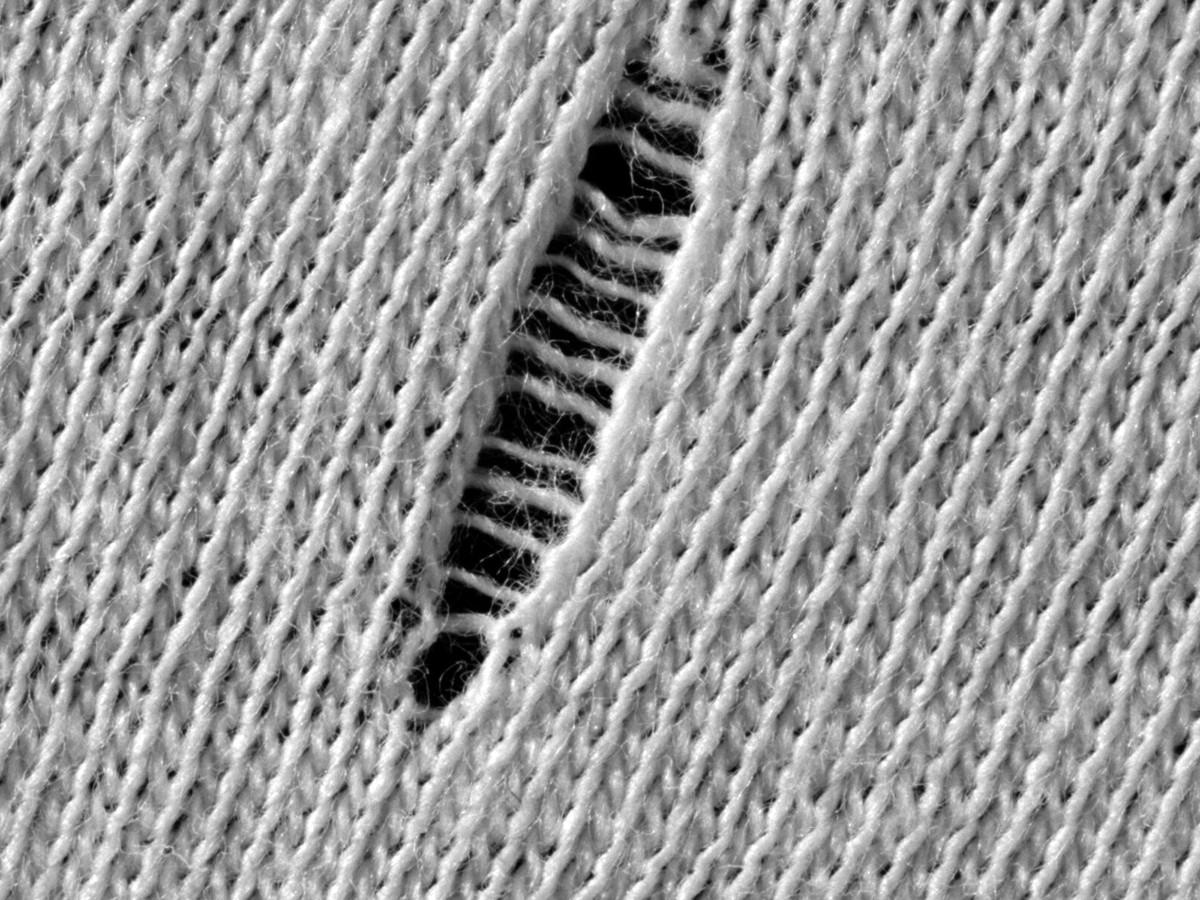
A dropped stitch is a stitch left unknit: a needle got no yarn, or a needle or jack failed, and the loop never formed. It shows as a hole or a missing stitch. Stitches that drop one after another down a wale make a run, also called a ladder.
What ConductVision Textile records
ConductVision Textile is designed to flag each defect with its place on the roll, its size, its points and a still image. Your inspector names the defect and confirms or dismisses it.
On the defect map in the roll report, a dropped stitch is a spot, and dropped stitches down one wale are a line along the roll.
What dropped stitches are
Cotton Incorporated's textile glossary describes the moment a drop stitch happens: "When a knitting needle clears the old stitch and does not receive a yarn to form a new stitch, a drop stitch is made" 1. Its fabric defect glossary traces its dropped stitch examples to "a malfunctioning needle or jack" 2.
A U.S. military glossary of knitting imperfections defines a drop stitch as "an unknitted stitch," and a split stitch as one where "one end of yarn of a stitch is knit and the other end dropped" 3. Where the yarn is not knitted by several needles side by side, the drop stitches lie together in a patch, which a university module on knit defects calls cloth fall-out 4.
What causes dropped stitches
Every cause below is at the knitting machine or in the yarn it feeds.
| Stage | What happens | What to check |
|---|---|---|
| Knitting | A needle or jack malfunctions, and the stitch fails to form 2. | Needles and jacks |
| Knitting | The yarn feeder is set wrong and offers the yarn to the needle at an unfavorable angle 4. | Feeder settings |
| Knitting | Yarn tension is too high, the yarn is overfed or underfed, or fabric take-down tension is too high 5. | Yarn tension on every feeder, the feed rate and take-down |
| Knitting | Wax and fluff clog the eyelets, yarn guides and tension discs and block the yarn path 5. | Eyelets, guides and tension discs |
| Knitting | The gap between the dial and the cylinder does not suit the loop size 5, 4. | The dial and cylinder gap, against the knitted loop size |
| Yarn | Slubs, neps and big knots in the yarn 5. | Yarn faults, before the yarn reaches the machine |
Where dropped stitches show on a roll
Dropped stitches recur "in one or more wales within a length of a knitted fabric" 3, and a wale is the "vertical column of loops produced by the same needle knitting at successive knitting cycles" 1. Cotton Incorporated lists its dropped stitch examples as warp lines, or vertical lines 2. So one dropped stitch is a spot, and dropped stitches that repeat run along the roll, not across it.
How dropped stitches count
Cotton Incorporated's defect glossary rates its dropped stitch examples as major defects 2. Its grading guide defines a major defect as one severe enough, if exposed, to make the end item a second 6.
A dropped stitch that leaves an opening falls under the rule for holes and openings: in the 4-point table one trade guide sets out, 1 inch or less scores 2 points and over 1 inch scores 4 7. A missing stitch with no opening is scored by its length: 1 point up to 3 inches, 2 points over 3 up to 6 inches, 3 points over 6 up to 9 inches and 4 points over 9 inches 7.
Dropped stitches that continue along the roll are a running defect. One buyer manual, which follows the 4-point system of ASTM D5430, gives up to 4 points to each linear yard or metre in which a continuous running defect exceeds 9 inches, and no linear yard gets more than 4 points 8.
What research says
A 2020 trial knitted single jersey from 30 Ne cotton yarn on one 24-gauge circular knitting machine and changed the yarn input tension three ways: through the yarn delivery rate, and through the stitch cam setting, changed at all the cams together or at one cam. Each way, higher tension brought drop stitches. Of the four defects the trial found (drop stitches, holes, runs and press-offs), drop stitches and holes were "the prominent ones" 9.
On that yarn and machine, when the cams were changed together, drop stitches became significantly more frequent once yarn tension passed about 10 cN (centinewtons), measured just before the yarn entered the knitting zone. When the delivery rate was changed instead, the number of defects rose significantly once tension passed 8 cN 9.
Sources
- 1Cotton Incorporated, Textile Glossary
- 2Cotton Incorporated, Standard Fabric Defect Glossary
- 3U.S. Department of Defense, MIL-STD-1491, Glossary of Knitting Imperfections (1971)
- 4S. Natarajan, Knitted fabric defects, chapter 17 of Textile Manufacturing and Testing, e-PG Pathshala, INFLIBNET
- 5M. A. Taher, M. M. Rahman, M. A. Jahangir, M. S. Mia and Ashaduzzaman, Study on different types of knitting faults, causes and remedies of knit fabrics, International Journal of Textile Science 5(6), 119-131 (2016)
- 6Cotton Incorporated, Visual Inspection and Grading of Fabrics
- 7P. Joshi and A. Trivedi, Fabric Inspection System and Machines, Fibre2Fashion
- 8DXLG Fabric Inspection Guidelines, version 1.1
- 9A. K. M. M. Hossain, M. I. Islam and S. U. Patwary, Effect of yarn delivery and couliering depth on yarn input tension and fabric defects for positive-feed based circular knitting machines, International Textile and Apparel Association Annual Conference Proceedings 77(1) (2020)
Pilot - How a pilot starts
We start with recorded video of your inspection frame and agree with your team on one fabric to test. The pilot runs for a set time, and before it starts we agree on what counts as success. For each defect it marks, ConductVision saves a still image and its place on the roll on your network for your inspector to check.
- You bring
- Recorded video of fabric running over your inspection frame
- We set up
- One fabric, and the limit you grade it against
- You get
- Marked defects, running points and a final points forecast for each roll, and a results report checked against what we agreed
One question to start with
Which knit fabric shows dropped stitches most often?
Related pages
- Runs and laddersStitches that unravel down a wale.
- HolesAn opening where yarns have broken or been cut.
- Needle linesA lengthwise line in a knit that follows one wale.
- Defect positionWhat a defect's place on the roll points to
- Defect sizeHow a defect's length sets its points
- Fabric defect libraryWoven, knit and yarn defects, and how they are measured