
Fabric defect · Knit fabric - Press-offs in knit fabric: causes and how they count
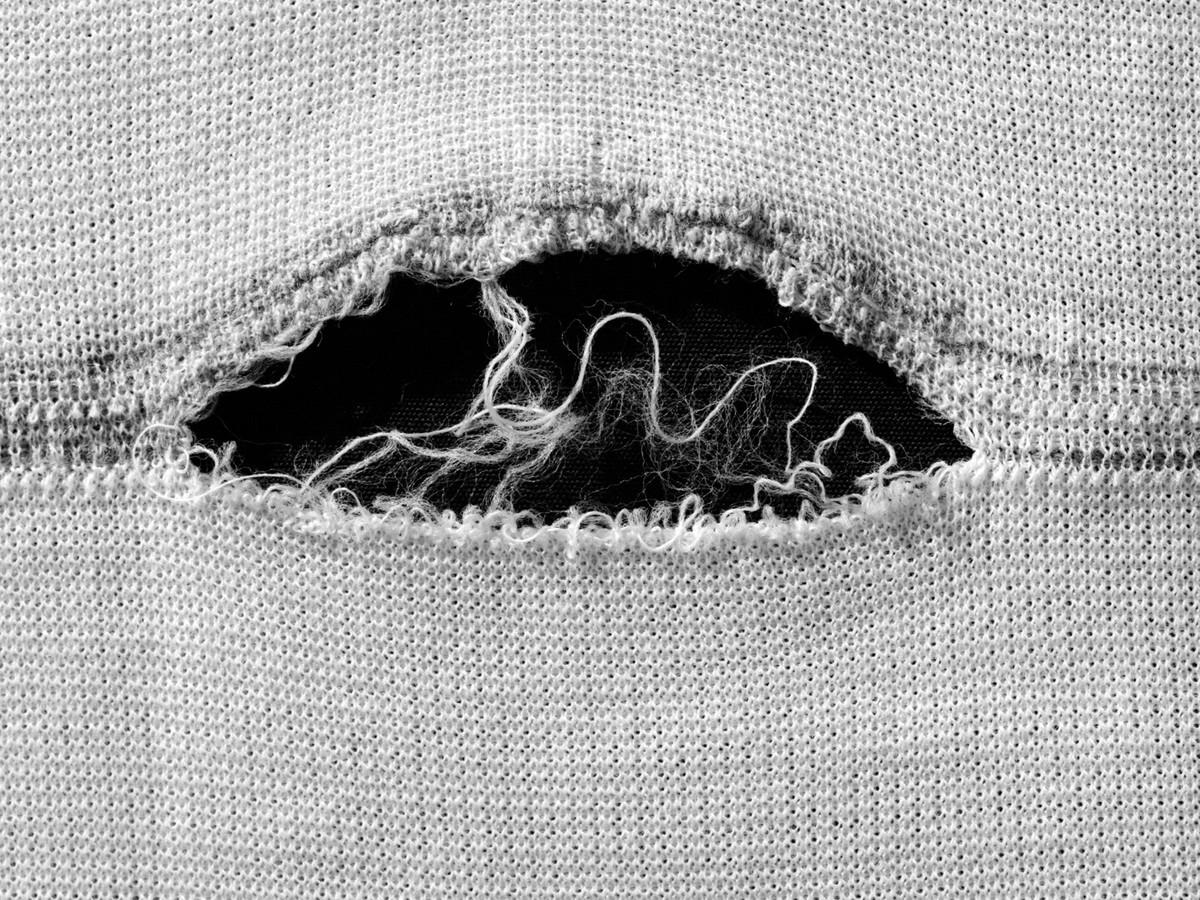
A press-off is a place where some or all of the needles on a circular knitting machine stop knitting. The fabric either falls off the machine or comes out with a large hole, and in one study of greige knit fabric it was the second most common defect.
What ConductVision Textile records
ConductVision Textile is designed to flag each defect with its place on the roll, its size, its points and a still image. Your inspector names the defect and confirms or dismisses it.
On the defect map in the roll report, a press-off is a large hole, or a line across the width.
What a press-off is
Cotton Incorporated's defect glossary describes a press-off in circular knits as a condition where "all or part of the needles cease to function" and the fabric either falls off the machine or its design is disrupted or destroyed 1. A U.S. military glossary of knitting imperfections defines a press off as a "condition arising when fabric fails to knit and either falls off the machine or results in a large hole in the fabric" 2.
A press-off starts at the knitting machine. One study of greige knit fabric traces it to a yarn end that breaks at a feeder, or to yarn that a badly placed feeder fails to lay into the needle hooks 3.
What causes press-offs
Every cause below is at the knitting machine, where the yarn reaches the needles.
| Stage | What happens | What to check |
|---|---|---|
| Knitting | A yarn end breaks at a feeder 3. | Yarn ends at the feeders |
| Knitting | A feeder out of position fails to lay the yarn into the needle hooks 3. | Feeder position for the needle size, and the needle detectors |
| Knitting | Yarn tension too high or too low. In one trial on a single jersey machine, press-offs were one of four defects that came from changes in yarn tension. For that yarn and machine, defects rose significantly once the tension went above 8 cN (centinewtons) 4. | Yarn input tension and the yarn delivery rate |
Where press-offs show on a roll
Cotton Incorporated's defect glossary files press-offs under "weft lines, horizontal lines" 1. A U.S. military glossary describes the result as a large hole, or fabric that falls off the machine 2.
Where a press-off leaves a hole, read it the way you read other holes. Goldberg's first step with holes was to find how often they occur and how they are spread, because the repeat of the damage, or the lack of one, is often the clue 5.
How press-offs count
Cotton Incorporated rates a press-off a major defect in its defect glossary 1. Its grading guide calls a defect major when it is severe enough, if exposed, to make an end item a second 6.
Where a press-off leaves a large hole, the hole rule applies: one trade guide scores a hole over 1 inch at 4 points 7. A press-off line across the full width is longer than 9 inches, so it scores 4 points too. Under the 4-point system, no linear yard or metre gets more than 4 points, however many defects it holds 6. Your buyer's manual sets the rule.
What research says
A 2020 study graded three months of greige single jersey, fleece and 1x1 rib from one circular knitting mill in Bangladesh by the 4-point system. Overall, press-offs came second only to gout, both in how often they appeared and in the points they cost 3. A federal glossary defines gout as "Waste that has been woven into the cloth, or spun into the yarn" 8.
In fleece, gout made up around three fifths of the defects found and press-offs came next. In rib, holes and press-offs together made up around two fifths, after gout and stain 3.
Sources
- 1Cotton Incorporated, Standard Fabric Defect Glossary
- 2U.S. Department of Defense, MIL-STD-1491, Glossary of Knitting Imperfections (1971)
- 3A. K. M. M. Hossain and M. I. Islam, Exploring weft knit fabric defects based on their presence and quality impact: a case study, Communications in Development and Assembling of Textile Products 1(1), 57-64 (2020)
- 4A. K. M. M. Hossain, M. I. Islam and S. U. Patwary, Effect of yarn delivery and couliering depth on yarn input tension and fabric defects for positive-feed based circular knitting machines, International Textile and Apparel Association Annual Conference Proceedings 77(1) (2020)
- 5J. B. Goldberg, Fabric Defects: Case Histories of Imperfections in Woven Cotton and Rayon Fabrics, McGraw-Hill (1950)
- 6Cotton Incorporated, Visual Inspection and Grading of Fabrics
- 7P. Joshi and A. Trivedi, Fabric Inspection System and Machines, Fibre2Fashion
- 8U.S. General Services Administration, Federal Standard No. 4b, Glossary of Fabric Imperfections (1964)
Pilot - How a pilot starts
We start with recorded video of your inspection frame and agree with your team on one fabric to test. The pilot runs for a set time, and before it starts we agree on what counts as success. For each defect it marks, ConductVision saves a still image and its place on the roll on your network for your inspector to check.
- You bring
- Recorded video of fabric running over your inspection frame
- We set up
- One fabric, and the limit you grade it against
- You get
- Marked defects, running points and a final points forecast for each roll, and a results report checked against what we agreed
One question to start with
Which knit fabric shows press-offs most often?
Related pages
- HolesAn opening where yarns have broken or been cut.
- Dropped stitchesA stitch left unknit, where a needle failed to form its loop.
- Runs and laddersStitches that unravel down a wale.
- Elastane faultsFaults in the stretch yarn of a knit.
- Defect positionWhat a defect's place on the roll points to
- Defect sizeHow a defect's length sets its points
- Fabric defect libraryWoven, knit and yarn defects, and how they are measured